
Read the Iosco County Property Tax Record
A property tax record in Iosco County is really a set of linked records, not one fixed page. Local assessors set parcel values and classifications first. County Equalization then checks uniformity and maintains the current plus past two years of assessment rolls, section maps, subdivision plats, recorded surveys, recent sale data, and computerized parcel information. The Treasurer handles both current and delinquent tax duties. Read those fields side by side. Otherwise a sale price, an assessed figure, or a tax balance can be mistaken for another.
| Field | What It Shows | Where |
|---|---|---|
| MBOR Assessed | The March Board of Review assessment shown for the year | FetchGIS or assessor card |
| Final SEV | State equalized value after equalization | FetchGIS and assessment roll |
| Final Taxable | The capped base used with millage to compute tax | FetchGIS, BSA, or roll |
| Tax status | Current or delinquent amount for the stated settlement date | BSA or County Treasurer |
| District and millage | The taxing units and rates applied to the parcel | Tax record and annual county reports |
Michigan's Proposal A framework ties assessed value to 50 percent of true cash value. It does the same for SEV. Taxable value is often lower. Its annual growth is capped at inflation or 5 percent, whichever is less. Additions sit outside that cap. A transfer usually uncaps taxable value in the next calendar year. Keep in mind that a sale price is just a transaction figure. It never automatically equals any assessment field on the parcel record.
Search Iosco County Tax Accounts in BSA
Iosco BSA Online serves as the county-linked starting point for current tax, delinquent tax, assessing, and detailed record searches. The landing page offers several search modes at once. Pick the property category before assuming a name hit is a parcel record, because the interface can also surface an animal-license entry.
| Search control | Best input | Use in tax research |
|---|---|---|
| Address | Street number and name | Find the parcel account tied to a known site |
| Name | Owner name as shown on the roll | Locate parcels assessed to a person or entity |
| Parcel Number | Complete PIN | Match the exact account across tax years |
The BSA view can limit detailed access under owner, resident, or pay-as-you-go terms. Save the PIN and tax year anyway. Even without a detailed screen, those keys work with Equalization or the Treasurer. The BSA search interface appears below. It carries Address, Name, and Parcel Number controls.
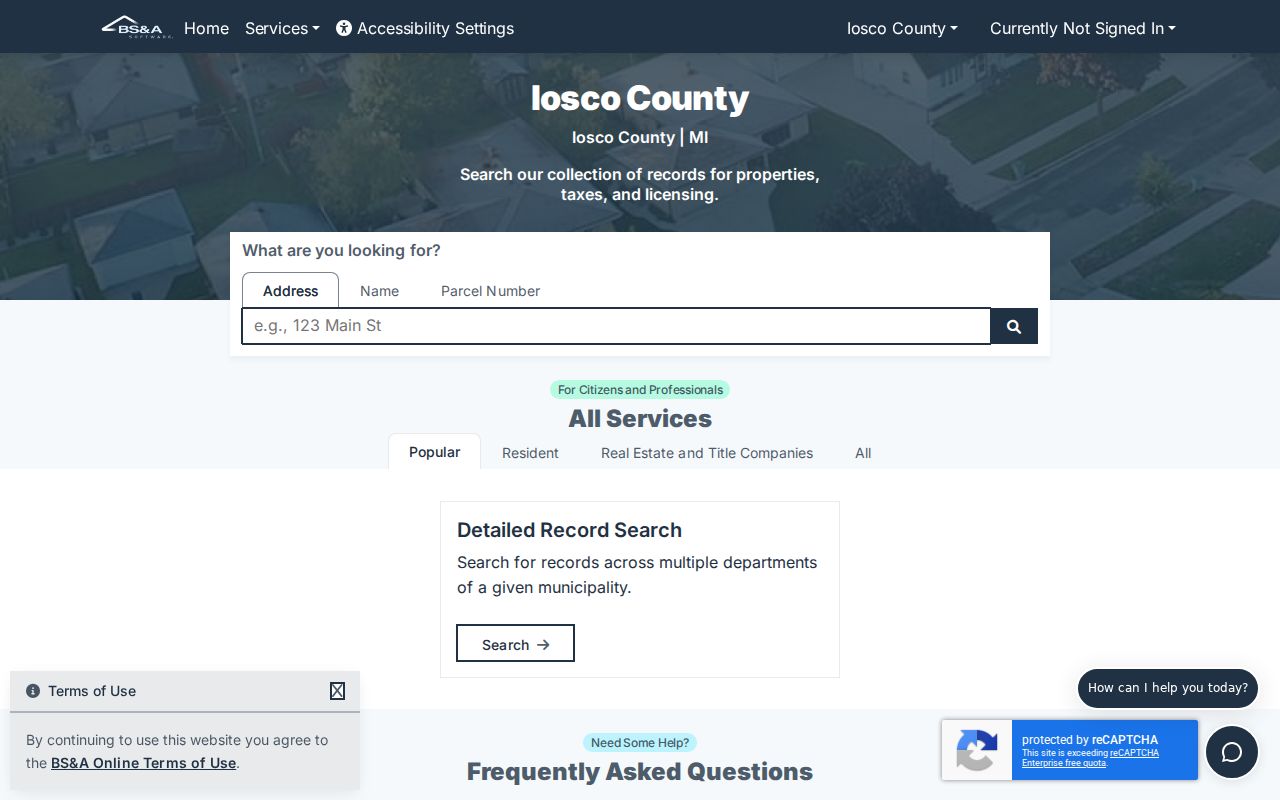
The screen makes clear why picking a record category belongs to a reliable tax lookup. It is not a step to skip.
Separate Iosco County SEV From Taxable Value
Three nearby figures can move on different schedules. True cash value is the assessor's estimate of market value. Assessed value is ordinarily half that amount, and SEV reflects state equalization. Taxable value is the capped base taxes are built on. It can uncap after a transfer. That distinction matters most when a buyer weighs the seller's old bill against the likely tax base in the year after closing. The two figures can differ sharply.
- Assessed value
- Generally 50 percent of true cash value under Michigan law.
- Taxable value
- The capped value to which millage is applied.
- Millage
- The set of local tax rates applied to taxable value.
- Principal Residence Exemption
- An exemption from school operating millage for a qualifying principal home, not proof of title.
- Tax lien
- A claim arising from unpaid property tax.
The Iosco County property value guide unpacks what each number really means.
Look Up an Iosco County Tax Bill
Treat both the assessment and the bill as dated snapshots. The property search supplies the parcel key. The tax account supplies the balance and status. The assessor record explains the value and exemption fields behind them. Once a tax goes delinquent, responsibility shifts. It moves from the local collecting unit to the county process.
- Search BSA by address, name, or the complete parcel PIN.
- Confirm the municipality and record category before opening the account.
- Write down the tax year, season, settlement date, total due, and payment status.
- Compare Final Taxable and exemption status with the assessor or FetchGIS report.
- For a delinquent year, confirm the payoff and accepted payment method with the County Treasurer.
Never carry a balance forward without its as-of date. Interest, notices, forfeiture charges, and redemption costs all shift during the delinquent-tax calendar.
Use Iosco County Millage Reports by District
The Equalization millage and rate reports add district context that a plain balance cannot. The county collection includes 2025 and 2026 equalization reports. Millage rates reach from 2006 through 2025. Forms such as L-4024, L-4402, L-4046, and L-4028 are there too. Top-taxpayer and district reports for Hale, Oscoda, Tawas, and Whittemore sit alongside them.
Match the parcel's tax district and year to the right report. A rate from another township, city, school district, or year does not explain the bill. That holds true even when the properties sit close together.
Note: A tax-rate report explains the levy framework. The parcel account remains the source for that property's billed and paid status.
Track Iosco County Delinquent Taxes by Date
The Iosco County Treasurer's delinquent-tax guidance lays out the sequence of notices. It also covers fees, forfeiture, foreclosure, and auction steps. For the documented 2023-tax cycle, summer and winter taxes first became delinquent. Notices followed in May, August, and November. Added stages continued through forfeiture and foreclosure. The page lists March 31, 2026 as the final foreclosure deadline. That deadline falls at 4:30 p.m. for the cycle.
| Stage | Record to retain | Why it matters |
|---|---|---|
| Delinquency | Original due date and account snapshot | Fixes the starting point |
| Forfeiture | Notice, title-search charge, fees, and interest | Shows redemption costs and status |
| Foreclosure | Hearing and deadline notice | Shows whether title has shifted |
| Auction | Assessed legal description and terms | Defines what the listing purports to sell |
Only certain payment forms are accepted for forfeited parcel payments under county guidance. Cash, money orders, and cashier's checks qualify. A hardship extension can stretch up to one year. It does not erase the taxes, and interest keeps running. Auction notices sometimes surface at tax-sale.info. Think twice before trusting any auction entry. Compare the assessed legal description against the deed, the plat, and the PIN.
Copy more than the latest balance. Build a date table instead. Log the summer and winter due dates, the delinquency date, each notice, the forfeiture, the title-search and redemption charges, and the foreclosure hearing. Add the county-title date and any auction or proceeds-claim milestone. A notice, a BSA balance, and an auction listing can each be accurate snapshots. They may be taken on different days. The dates explain the differences.
The Treasurer published estimated site-inspection costs and other charges for the documented cycle. Those figures shift as a case advances. Request a payoff pinned to a settlement date. Ask whether a hardship extension applies. Ask also which payment forms the office accepts at the parcel's current stage. One county warning deserves repeating: an auction rests on the assessed legal description and excludes personal property.
Read PRE and Ownership Changes in Iosco County
Michigan's Principal Residence Exemption shields a qualifying main home from school operating millage. The affidavit is a statement, not a title document. It records what the owner or occupant claims. It also lists the property address, the parcel number, and the assessor submission. Who holds title is a question for the deed records.
A transfer of ownership usually uncaps taxable value the next calendar year. The Register of Deeds notifies assessing officers of recorded transfers at least monthly. Iosco County promises no fixed roll-refresh interval, so check timing yourself. Compare the deed date against the following assessment year and the account's exemption status. Assuming the old tax bill predicts the next one is a mistake.
When you compare parcels, ask why a value moved. A sale explains some increases. New construction can shift the number too. An addition, a split or combination, a classification correction, or an exemption change can shift it as well. If BSA, FetchGIS, and the assessor card disagree, quote the field name, year, PIN, and access date from each source. Then ask the assessor to explain the timing or record category.
Challenge an Iosco County Property Assessment
Most classification and valuation disputes start at the local Board of Review, generally in March. The Michigan Tax Tribunal deadline for most property classes is July 31. Certain industrial, commercial, and developmental real or personal property matters may proceed directly by May 31. Such industrial and commercial matters skip the local board.
Rely on the municipality's notice for the exact year, hearing place, and petition procedure. Bring the assessment notice, parcel card, photographs, and comparable sales. Add the legal description and a short statement of the claimed error. County Equalization can supply rolls, recent sale data, maps, plats, and recorded surveys. Still, the local assessor and Board of Review control the first step.
Do not treat the July and December sessions as a second chance. They are not a venue for a full valuation protest. They cover only the limited categories in state guidance. Separate a factual clerical issue from a genuine disagreement. A real dispute involves true cash value, classification, or exemption. If the dispute moves past the local board, keep the petition, evidence list, hearing notice, board decision, and proof of timely filing.
Appeal window. Check the current local notice before acting. General state timing cannot replace the municipality's posted Board of Review schedule.