
Identify Who Owns an Iosco County Property
Ownership research in Iosco County follows a short chain of evidence. Start with the assessor and the GIS map, since both make an address searchable. From there, the deed index points to the recorded conveyance. Pull the newest deed image. Confirm the names and legal description. Then check that the two systems describe the same parcel of land.
- Search the address in Iosco BSA Online or FetchGIS.
- Copy the PIN, displayed owner name, Owner Address, record year, and access date.
- Search that owner as grantee in the DoxPop recorder index.
- Open the latest deed and compare grantee, legal description, and prior instrument reference.
- If an entity owns the parcel, use Michigan's official business registry to identify the entity record.
The assessor record shows who the tax system currently ties to the parcel. The deed shows who actually received the recorded interest. Those two answers can disagree after a recent sale. When they do, keep both dates and ask the assessor or the Register of Deeds instead of picking the answer you prefer.
Start the Iosco County Owner Search With the Parcel
Two Iosco County tools cover the first step. Iosco BSA Online lets you search by Address, Name, or Parcel Number, while Iosco FetchGIS accepts the five-part PIN, an owner name, a street address, an intersection, or coordinates. FetchGIS shows a separate Owner Address field. BSA adds a name-based search. Neither tool labels every view with a formal "Owner of Record" field, so read each screen with care.
Choose your starting point deliberately. An address works when you only know the location. A PIN is better once you have one, since it is far less ambiguous than a street name or a person. Try name variants only after copying the exact spelling shown. One caution: BSA result categories can include animal licenses, so confirm the hit is a property or assessing record before trusting the name as an owner.
The BSA interface displays the available starting controls on its opening page.
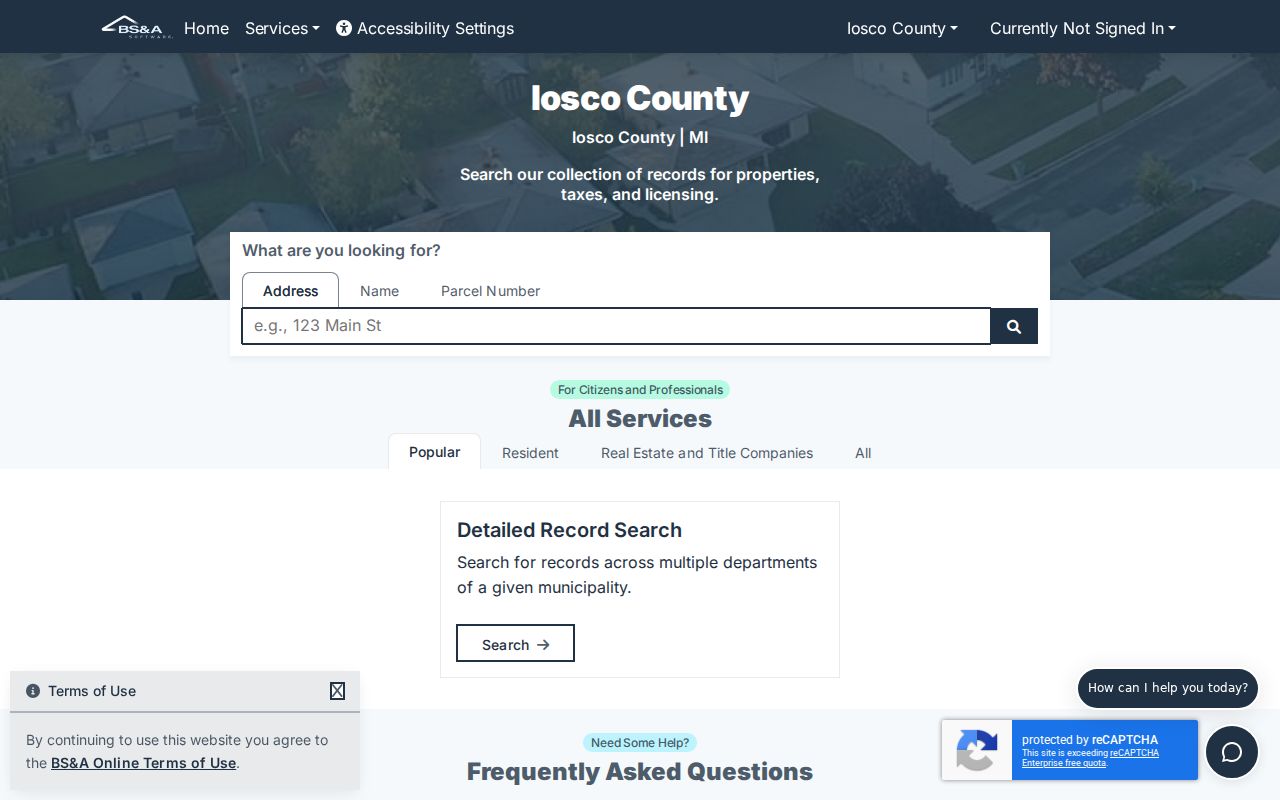
The result category and parcel number matter as much as the name on the screen.
Compare Iosco County Property Owner Sources
No single source answers every version of "who owns this property." Assessment records supply a current working name plus a mailing field. The Register of Deeds supplies the recorded conveyance itself. GIS ties those records to mapped land, and the state business registry can explain an entity name without changing what the deed says.
| Source | Owner Info It Gives | Access |
|---|---|---|
| BSA or assessment roll | Name tied to the assessed parcel and tax account | Online, local assessor, or Equalization request |
| DoxPop deed index | Grantee named in the recorded transfer | Online index or Register of Deeds office |
| FetchGIS report | Owner Address beside the selected PIN and property address | Online map and report |
| Michigan business registry | Official entity filing details | State public search |
The displayed owner is not always the occupant. A mailing address may be a post office box or a different location entirely. Keep the situs address, the owner mailing field, and the legal description separate, so an address match never becomes an unsupported claim about identity.
Confirm the Iosco County Owner With the Latest Deed
The Iosco County Register of Deeds records deeds, mortgages, surveys, land contracts, condominiums, subdivisions. It also records related instruments. The records begin in 1858 and have been digitized for security. The county notes, though, that the searchable index currently reaches only the early 1970s. Older material may require an office search.
Run the assessment owner's name as a grantee first. Then inspect the most recent conveyance touching the same legal description. Save the recording date, the instrument number or liber and page, the document type, grantor, grantee, parcel number if shown. Also save any prior instrument reference. Be careful here. A mortgage, discharge, lien, or easement is not automatically a deed that changes ownership.
The DoxPop Michigan recorder interface provides the deed records search view.
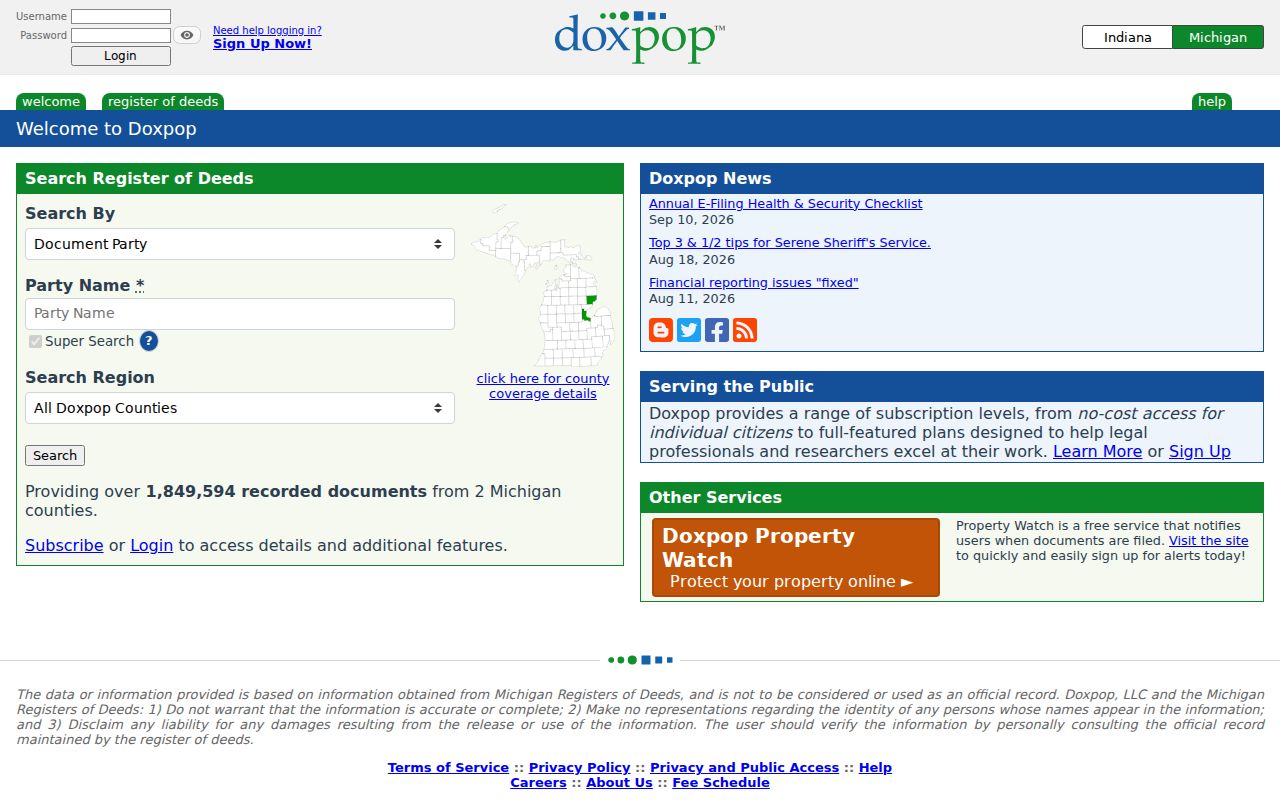
Field labels and index mechanics can change as interfaces update. Use the current screen and keep the instrument citation you find.
Date-Stamp an Iosco County Ownership Result
Michigan guidance requires the Register of Deeds to notify the assessing officer of recorded ownership transactions. This notice must happen at least monthly. That rule describes the handoff between offices, not an instant public-roll refresh. Iosco County publishes no guaranteed refresh interval or typical deed-to-roll delay.
After a recent sale, save four dates. These are the deed date, the recording date, the displayed assessment year, and your search date. The newest recorded deed may be more current than the assessment name. If BSA, FetchGIS, and the deed disagree, contact the local assessor. Also contact the Register of Deeds with the PIN and instrument reference in hand.
Note: A portal conflict is a research lead, not proof that either named party acted improperly or that title is defective.
Continue an Iosco County Owner Search Offline
Digital results are just one channel. For the full record set, visit Iosco County Equalization. The office keeps current and past two years of assessment rolls, section maps, subdivision plats, recorded surveys, and recent sale data. The office sits at 422 W Lake Street in Tawas City. Hours run Monday through Thursday, 8:30 a.m. to 4:30 p.m. The office is closed from 1 to 2 p.m. Call 989-984-1111 and have the municipality, PIN, street address, owner spelling, and requested years ready. That preparation speeds up any owner-of-record lookup.
The Register of Deeds works from the same courthouse street address. In-person deed records research is welcome Monday through Friday, 8:30 a.m. to 4:30 p.m. Mail goes to PO Box 367, Tawas City, MI 48764, and the phone is 989-362-2021. Researchers may search records themselves, including older material. Staff will not run a title search or give legal advice. Plan to do the parcel work on your own. For copies, bring the instrument number or the liber and page. Have those ready once you have located the deed.
Sometimes an assessment or administrative record is not available through the portal or normal office process. The custodian still owes you a response under the Michigan Freedom of Information Act. Send a narrow written request. Name the record type, date range, municipality, and parcel number. Say whether you want inspection or copies. A reply is generally due within five business days, though a written ten-business-day extension is possible. Lawful search, review, separation, copying, and mailing charges may apply.
Watch New Iosco County Property Owner Filings
After you identify the current instrument, DoxPop Property Watch provides a recording-alert route. Enrollment and payment terms live on the application itself. Rely on the current sign-up details. Treat an alert as a prompt to pull the official image. It is not proof that ownership changed or that fraud occurred.
Compare each alert against the known parcel record. Check the grantor, grantee, document type, legal description, and prior instrument reference. A legitimate mortgage, discharge, assignment, easement, or unrelated filing can name a familiar person. It may not convey the property at all. That distinction makes alerts useful for early review. The official deed image stays the checkpoint. The Property Watch sign-up screen appears below.
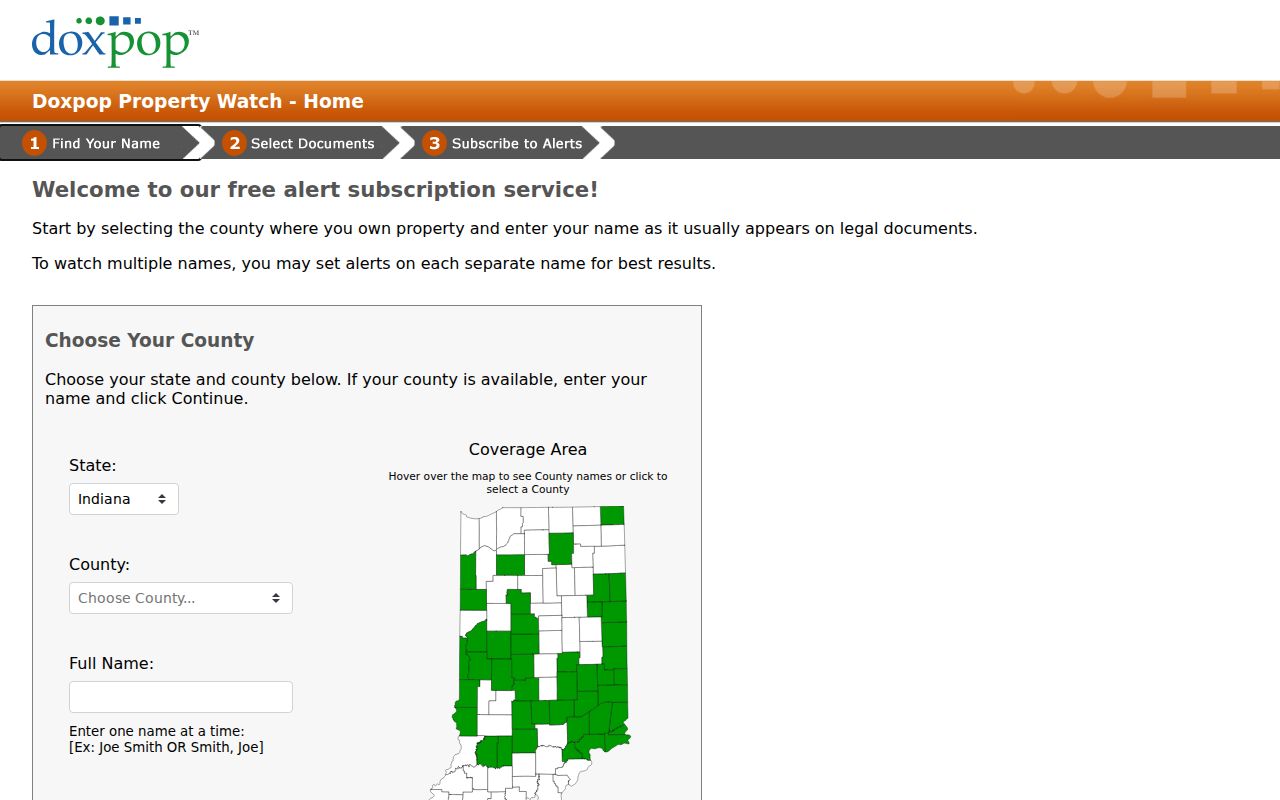
The image shows the same point plainly. Notification is an application service layered on the county's recorded documents, not an ownership database of its own.
Read Trust, Estate, and LLC Owners in Iosco County
A parcel can be vested in a trust, estate, corporation, or limited liability company. It need not belong to a natural person. Copy the entity name exactly. Include initials, punctuation, trustee wording, and corporate suffixes. Then search the deed image for the full grantee language and the legal description. For a Michigan entity, the MiBusiness Registry Portal can supply the official filing record. A probate file may explain an estate transfer. But the title-facing checkpoint remains a recorded deed or certified order. The ownership lookup should state the named legal owner of record. It should not infer who occupies, controls, or benefits from the land.
- Owner of record
- The name carried in the current official record being consulted.
- Grantee
- The person or entity receiving the interest in a deed.
- Vesting
- The way the deed states that title is held.
- Situs address
- The property's physical location.
- Mailing address
- The address used to send owner or tax correspondence.
Know the Limits of an Iosco County Owner Lookup
An owner-name result has firm limits. It does not prove who lives at the address, settle competing title claims, or disclose unrecorded interests. It never replaces a professional title search. A GIS boundary is not a survey. An assessment name exists for property administration. An owner mailing address can sit far from the parcel itself.
Michigan's Address Confidentiality Program supplies designated addresses and mail forwarding for qualifying people. These people face specified safety risks. Government agencies must accept the designated address. Public availability of other records does not cancel redactions, sealing, or safety protections.
A records search also cannot decide whether an unrecorded claim, boundary agreement, probate issue, or court order affects title. Ownership can control a purchase, sale, inheritance, or legal dispute. In those cases, take the PIN, deed references, and legal description to a title professional or attorney. County offices provide records and copies. The Register of Deeds expressly does not draft instruments or interpret their legal effect.
Lawful use. Use Iosco County owner information for legitimate parcel research, purchase diligence, estate work, or civic review. Never use it to stalk, harass, or harm anyone.