
Trace Former Iosco County Owners Across Time
The deed chain is the spine of the work. Rolls, plats, probate files, and archives supply dated clues whenever a name index runs dry. Use each source only for what it truly proves.
| Source | Coverage | Access point | Best evidence |
|---|---|---|---|
| DoxPop deed index | Current index reaches the early 1970s | Online and Register of Deeds | Grantor, grantee, and instrument leads |
| Older deed books | County deeds date to 1858 | Register of Deeds office | Earlier conveyances and legal descriptions |
| Rural property inventory | 1936 to 1942 | Archives of Michigan | Property and owner bridge clues |
| Assessment and tax rolls | 1891 to 1940 and 1887 to 1940 | Archives of Michigan | Assessed names by place and year |
A recent transfer can be traced online. When the deed sits before the current index boundary, though, the office is the place to look.
For nineteenth-century digging, use the clues in Archives to locate the original conveyance.
The Iosco County Index Boundary Is Not a Records Boundary
The Iosco County Register of Deeds reports land records beginning in 1858. All of them are digitized for security. The online index, however, reaches back only to the early 1970s. Digitized is not the same as searchable. An Iosco County deed search may stop at the online cutoff. The chain of former owners has not stopped there. Older books and indexes live at the office. The Register of Deeds sits at 422 W Lake Street in Tawas City. Mailing goes to PO Box 367. Hours are Monday through Friday, 8:30 a.m. to 4:30 p.m. Staff allow genealogy research. They will not run a title search for you.
Read the Latest Iosco County Deed First
Pull the current PIN, address, displayed owner, owner mailing address, legal description, sales clue, and tax year. BSA or FetchGIS supplies those fields. They set the direction of the search. Then read the newest deed image for recording date, instrument number or liber and page, document type, and grantor. It also shows the grantee, legal description, prior-instrument reference, exhibits, and page count. The DoxPop Michigan recorder interface is the documented online entry point for this work.
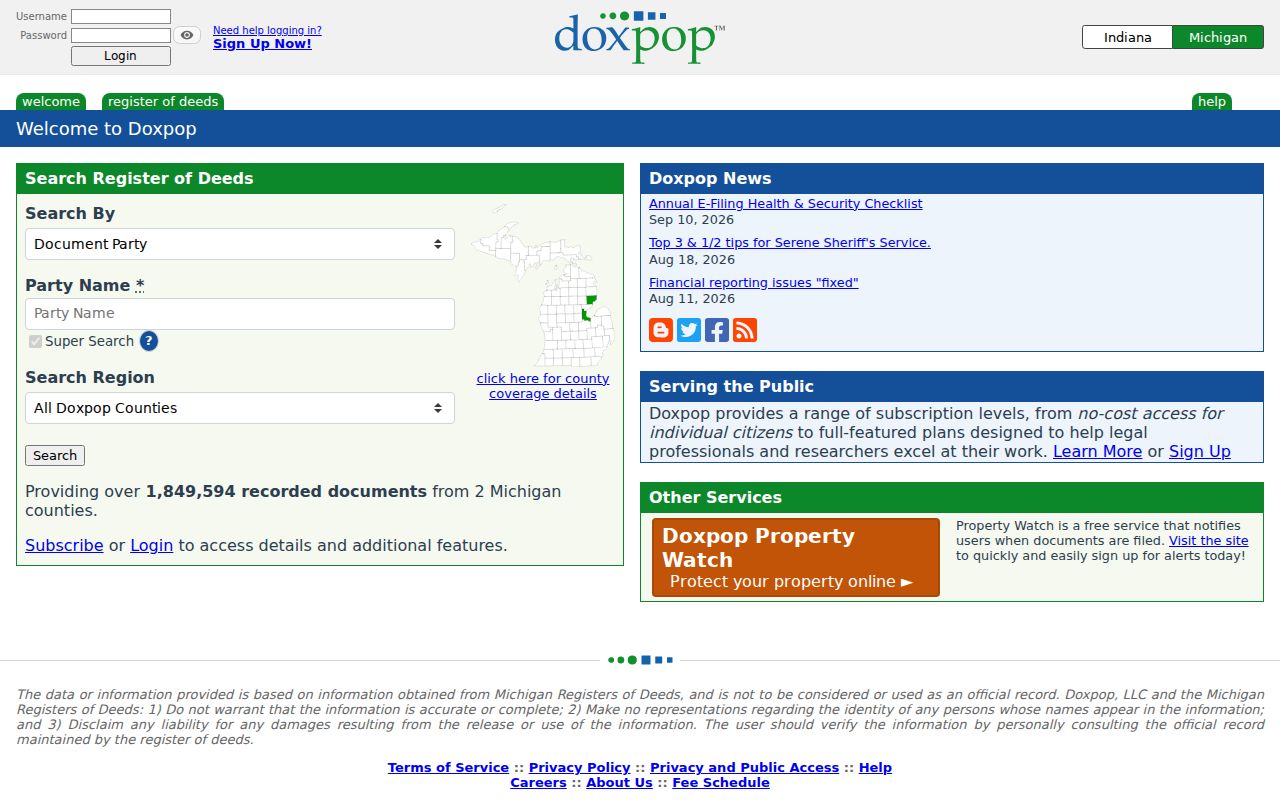
The recorder search page loads its fields through live JavaScript. So on-screen labels, result limits, export options, payment steps, and earliest searchable year can shift. Record exactly what the screen shows on the day of the search. A mortgage discharge, lien release, assignment, covenant, easement, or plat can matter greatly. It may not change the owner of record, though. The county FAQ notes that paying off a mortgage produces a discharge. That is not a new deed. Classify each Iosco County deed document before treating a named party as a former owner.
Walk Iosco County's Deed Chain Backward
Log one row per transfer. Never leap from a current tax-roll name straight to an older roll name without the deed record that links them.
- Find the current owner's acquiring deed with that owner as grantee.
- Read the grantor and prior instrument or liber/page reference.
- Search that grantor as a grantee to locate the prior acquisition.
- Repeat while matching the legal description at every link.
- Move to office deed books when the online chain reaches its limit.
Grantor: the party conveying an interest. It is the name to chase in the reverse index. Grantee: the party receiving that interest. Reverse index: the tool for finding the other side of a transfer. Chain of title: the ordered run of instruments affecting ownership.
Note: Search a deed's grantee as grantor in the next step; that reversal is the engine of the backward chain.
Bridge Pre-1970s Iosco County Former Owners
The Archives of Michigan Iosco County Guide bridges the gap. It helps when an older parcel hides from a modern PIN. Its rural property inventory covers 1936 to 1942. Assessment rolls span 1891 to 1940. Tax rolls run 1887 to 1940. From these series you can pull a likely owner of record, township, and date range. The Archives also lists probate transfers of estates from 1853 to 1875. Real-estate sales run from 1888 to 1904, alongside court and probate series. A probate file may explain an estate passage that looks nothing like a sale. Carry each clue back to the deed or certified order behind it.
Iosco County Plats Preserve Older Parcel Identity
Street names and parcel numbers change. Subdivision, block, and lot references usually survive as the bridge. Search addition names as controlled terms, and normalize apostrophes, abbreviations, and the words addition, subdivision, village, and plat before concluding two references describe different places. Named Iosco County plats include Newmans, Northland No. 1, Earl Bennington's, Tawas Lake Park, P. Hazen's, F. Scheffler & Co., Harry Goldsmith, Porterfields, O'Farrell's, and Hurford's. A plat fixes a historic lot and its public ways, but a later deed may reflect a replat, split, combination, metes-and-bounds description, reservation, or easement. Match the legal description at every step.
Names Shift in an Iosco County Ownership Chain
Indexes can split initials, married names, trusts, and company suffixes. These variations can defeat a simple query. Search the exact deed spelling first, then supported variants. A business name can be checked in Michigan's MiBusiness Registry Portal. An entity filing never replaces the conveyance itself. Preserve each spelling beside the instrument that used it. Never merge similar names just because the parcel or surname looks right. In Iosco County deed records, the legal description gives strong continuity. Prior-deed references do the same, and both beat any street address.
Newspapers Lead Back to Iosco County Deeds
Old newspapers open surprising paths into Iosco County property records. The Library of Michigan holdings list covers the Iosco County Gazette from 1868 to 1914. It also includes selected years of the Tawas Herald. The Huron Shores Genealogical Society reports more than 1,400 indexes holding over 1.6 million indexed names. MIGenWeb adds township, probate, map, and street-name leads. A single item can surface an obituary, a probate date, an addition name, a road vacation, or a tax-sale notice. None of that proves ownership by itself. Write down the publication, date, page or image number, and search term. Also note whether you saw an index or the original. Then carry the clue back to the deed, plat, probate order, or tax roll. That document settles it.
Keep an Iosco County Former-Owner Timeline
A useful chain makes uncertainty visible instead of smoothing it away.
| Transfer date | Grantor to grantee | Instrument | Reference |
|---|---|---|---|
| Newest recorded date | Current deed parties | Exact deed type | Instrument or liber/page |
| Prior recorded date | Previous transfer parties | Exact deed type | Prior reference |
| Earlier book date | Former owners from office index | Original classification | Book and page |
Keep the deed date and the recording date in separate columns. When an assessment owner and a deed grantee disagree, report both with the source and year instead of silently picking one.
How Far Back Iosco County Former Owners Go
Iosco County's deed series begins in 1858. The Archives guide carries estate-transfer material into the 1850s and points to court, probate, assessment, and tax holdings as well. Expect a chain to wander across custodians before it reaches the origin you want. The county itself adds a wrinkle: laid off as Kanotin County in 1840 and organized in 1857, it can leave early land references without the modern name. That quirk trips up many a property search.
Access runs along four roads. Look online through DoxPop, visit the Register of Deeds in person, send a focused office inquiry, or seek Archives finding-aid assistance in Lansing. When an identifiable agency record sits beyond those indexes, the Michigan Freedom of Information Act lets you request it by describing the parcel, municipality, names, series, and years. Court and Archives records follow their own copy procedures.
Use Iosco County Previous-Owner Records With Care
Tracing Iosco County previous owners serves real purposes. House history, estate work, boundary study, and purchase diligence. It does not license publishing needless personal details. It also does not permit chasing a living person through an old address. Cite the official source, the query, the instrument or roll reference, and the access date. Another reader should be able to audit every conclusion.
Work from index to original for the safest results. A newspaper or genealogy entry suggests the name. A tax roll places it in a year. The recorded deed or certified probate order then establishes the land-facing event. For a single document and its copy options, see the Iosco County deed records guide.